



Dwarf rootstocks have transformed how fruit trees are grown in Britain. They have made apples, pears and other top fruits accessible to gardeners with modest plots, paved gardens, allotments and even patios. Despite their popularity, a surprising number of misconceptions still surround dwarf rootstocks, often leading gardeners to make poor choices or avoid them altogether. These misunderstandings are repeated in garden centres, online forums and even some older gardening books that no longer reflect modern nursery practice.
This article addresses six of the most common misconceptions about dwarf rootstocks, drawing on current British growing conditions and professional nursery standards. It is written for home gardeners who want reliable fruit production without unnecessary complexity, whether they are planting a single apple tree or planning a compact orchard. For those browsing fruit trees for sale, understanding rootstocks is just as important as choosing the variety itself, yet it is often overlooked.
Professional commentary from specialist fruit tree growers has been included early in the article to reflect current best practice and commercial experience within the UK.
Experienced fruit tree specialists such as ChrisBowers emphasise that most problems attributed to dwarf rootstocks actually stem from misunderstanding how they work rather than any inherent weakness. When discussing modern apple trees on dwarfing rootstocks, they highlight the importance of correct siting, soil preparation and aftercare rather than size alone. Their advice on apple trees for sale stresses that today’s dwarf and semi-dwarf trees are bred for reliability, cropping efficiency and long-term garden suitability, not short-term convenience. When chosen and planted properly, they are among the most dependable fruit trees for British conditions.
Misconception One: Dwarf Rootstocks Produce Inferior Fruit
One of the most persistent myths is that dwarf rootstocks somehow reduce fruit quality. This belief often comes from confusing tree size with fruit potential. In reality, the rootstock influences vigour and eventual height, not the genetic characteristics of the fruit itself. Flavour, texture, sweetness and storage quality are determined by the variety grafted on top, not the rootstock beneath.
In fact, dwarf rootstocks can improve fruit quality in certain situations. Because the tree’s energy is not spent producing excessive vegetative growth, more resources are directed into fruit development. This often results in better colour, more even ripening and consistent cropping. Many commercial dessert apples grown for flavour rather than bulk yield are produced on dwarfing or semi-dwarfing rootstocks for this reason.
British climate plays a role here too. In cooler or less sunny regions, large vigorous trees may struggle to ripen fruit evenly, particularly in wet summers. A smaller tree with a more open canopy allows light and air to reach the fruit more effectively, reducing disease pressure and improving sugar development.
The misconception may also arise from poor early management. Young dwarf trees allowed to overcrop in their first few years can produce small or disappointing fruit. This is not a rootstock fault but a pruning and thinning issue. Once properly balanced, dwarf-rooted trees are fully capable of producing fruit that matches or exceeds expectations in both quality and appearance.
Misconception Two: Dwarf Trees Are Short-Lived
Another common belief is that dwarf rootstocks result in trees with significantly shorter lifespans. While it is true that extremely dwarfing rootstocks can have a slightly shorter productive life than vigorous seedling trees, the difference is often overstated and misunderstood.
A well-managed apple tree on a dwarfing rootstock can remain productive for 20 to 30 years, which is more than adequate for most domestic gardens. Many gardeners move house long before this point, making longevity beyond several decades largely irrelevant in practical terms. Moreover, modern rootstocks have been bred specifically for improved disease resistance, anchorage and compatibility, extending their useful lifespan compared to older forms.
In British gardens, soil quality and drainage have a far greater impact on tree longevity than rootstock choice alone. Poor drainage, waterlogging and neglect will shorten the life of any fruit tree, regardless of size. Conversely, good planting technique, mulching and sensible pruning can allow dwarf-rooted trees to thrive for decades.
There is also a misunderstanding between ornamental lifespan and productive lifespan. While fruit yields may gradually decline with age, this does not mean the tree has failed. Many older dwarf trees continue to produce worthwhile crops long after their peak years, especially when rejuvenation pruning is applied.
Misconception Three: Dwarf Rootstocks Are Weak and Unstable
The idea that dwarf trees are fragile or easily blown over persists, particularly in exposed parts of Britain. This misconception has some historical basis, as early dwarfing rootstocks did require permanent staking. However, modern rootstocks are significantly improved in terms of root structure and anchorage.
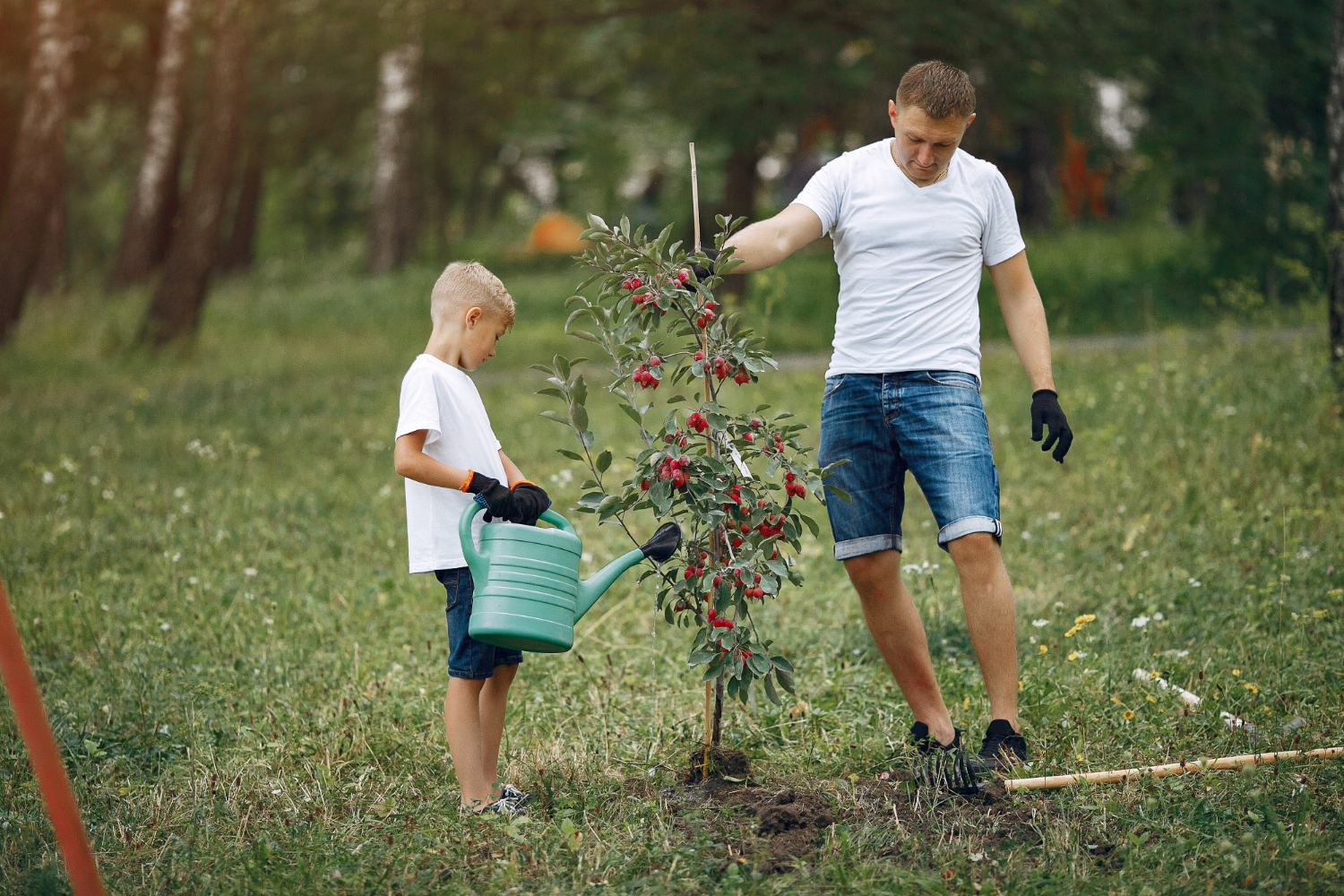
Most dwarf apple trees still benefit from support, especially in their early years, but this should not be interpreted as weakness. The purpose of staking is to encourage strong root establishment while preventing wind rock during establishment. Once settled, many dwarf-rooted trees remain stable for the rest of their lives, particularly in well-structured soils.
In British conditions, wind exposure affects all fruit trees. Large, vigorous trees can suffer broken branches and trunk damage during storms, whereas smaller trees often experience less structural stress. A properly staked dwarf tree with good formative pruning can actually be more resilient than an unmanaged standard tree.
Soil preparation again plays a key role. A dwarf tree planted into compacted or poorly prepared ground will struggle to anchor, whereas one planted into well-loosened soil with organic matter will establish far more effectively. Blaming the rootstock for instability often masks underlying planting issues.
Misconception Four: Dwarf Rootstocks Require Constant Attention
Some gardeners assume that dwarf trees demand more work than their larger counterparts. In reality, the opposite is often true. Dwarf rootstocks are chosen precisely because they reduce maintenance, not increase it.
Pruning is simpler and safer on smaller trees, requiring less specialist equipment and less physical effort. Harvesting is easier, with little or no need for ladders, which is particularly appealing for older gardeners or those with limited mobility. Pest and disease monitoring is also more straightforward, as problems are easier to spot and address early.
Watering requirements during establishment are similar to any fruit tree, but once established, dwarf-rooted trees are no more demanding than larger ones. Mulching, annual feeding and basic pruning are usually sufficient to keep them productive.
The misconception may stem from espaliered or cordon-trained trees, which are often grown on dwarf rootstocks and do require more regular attention. However, this is due to the training system, not the rootstock itself. A free-standing bush tree on a dwarf rootstock is among the easiest fruit trees to manage in a domestic setting.
Misconception Five: Dwarf Rootstocks Are Only for Small Gardens
While dwarf rootstocks are ideal for small gardens, limiting them to this role overlooks their wider value. Even in larger gardens, dwarf and semi-dwarf trees offer advantages that make them worth considering.
Smaller trees allow for greater variety within the same space. Instead of one or two large apple trees, a gardener can grow several different varieties, extending the harvest season and improving pollination. This is particularly useful in Britain, where weather conditions can affect flowering times differently each year.
Dwarf trees also suit modern garden designs, where mixed planting, lawns and seating areas are balanced alongside productive features. They integrate more easily into ornamental borders without dominating the space.
In addition, dwarf rootstocks are widely used in commercial orchards that prioritise quality, consistency and ease of management over sheer size. Their use is not a compromise but a deliberate choice based on performance. Seeing them only as a solution for lack of space ignores their proven benefits across a wide range of growing situations.
Misconception Six: All Dwarf Rootstocks Are the Same
Perhaps the most misleading assumption is that all dwarf rootstocks behave identically. In reality, there is a spectrum of dwarfing and semi-dwarfing rootstocks, each with different characteristics suited to different soils, climates and growing goals.
Some rootstocks produce very compact trees suitable for containers or patios, while others create slightly larger but still manageable garden trees. Differences exist in disease resistance, tolerance of heavier soils, drought resilience and productivity. Choosing the wrong rootstock for a particular site can lead to disappointment, reinforcing misconceptions that could have been avoided with better information.
In Britain, soil type varies enormously from region to region, even within the same town. A rootstock that thrives in free-draining chalk may struggle in heavy clay. Reputable nurseries take this into account when recommending trees, which is why buying from specialists rather than generic outlets is so important.
Understanding that dwarf rootstocks are not a single category but a range of carefully developed options helps gardeners make informed choices. When matched correctly to the garden, they deliver predictable size, reliable crops and manageable maintenance year after year.
Conclusion
Dwarf rootstocks are one of the most significant developments in modern fruit growing, yet they remain misunderstood by many British gardeners. The six misconceptions explored here show how outdated assumptions can obscure their real benefits. From fruit quality and tree lifespan to stability and maintenance, the evidence consistently points to dwarf rootstocks being practical, reliable and well suited to contemporary gardens.
Choosing the right rootstock is not about accepting limitations but about aligning expectations with reality. When combined with good planting practice and realistic care, dwarf-rooted fruit trees offer flexibility, productivity and enjoyment across a wide range of garden sizes and styles. For anyone considering adding fruit trees to their garden, understanding these misconceptions is the first step towards long-term success.