
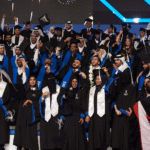





Saudi Arabia’s trailblazing institution is building one of the largest pipelines of women in technology the region has ever seen.
While women represent just 34% of STEM graduates in the United States, the Middle East tells a strikingly different story. Across the region, women now account for 57% of STEM graduates — a statistic that is reshaping conversations about gender and innovation on a global scale. Leading this shift is Effat University, the first institution in Saudi Arabia to offer engineering degrees to women, with more than 700 students currently enrolled across Computer Science, Electrical and Computer Engineering, and Information Technology programs.
“The Middle East is witnessing a paradigm shift,” says Dr. Zain Balfagih, Dean of Effat College of Engineering. “Families and communities are increasingly supporting women in STEM, recognising their contributions to innovation.”
Effat University has long positioned itself at the intersection of academic excellence and workforce preparation — and that commitment is evident in how its programs are structured.
Designed for Employability from Day One
Effat’s STEM pathways begin with rigorous foundations in programming, data structures, and network systems, before guiding students into targeted specializations including Artificial Intelligence, Cybersecurity, and Data Analytics. These tracks are built to mirror actual workforce demands rather than academic theory alone.
Every student completes at least one industry-supervised internship and finishes their final year with a capstone project co-developed alongside an external industry partner. By the time students graduate, they carry not only academic credentials but verified, hands-on portfolios that demonstrate real-world problem-solving.
The results speak for themselves: 41.2% of Effat graduates find employment within six months of completing their degree. The university’s emphasis on micro-credentials, professional certifications, and career readiness modules helps bridge the transition between campus and career — particularly in Saudi Arabia’s rapidly expanding technology sector.
“Our students don’t just learn theory — they build solutions,” Dr. Balfagih noted. “By connecting them with industry leaders and encouraging innovation, we’re equipping them to lead in emerging fields that are critical to the Kingdom’s digital economy.”
Positioning Women at the Center of the AI Era
The global AI market is on track to reach $1.8 trillion by 2030, creating surging demand for skilled professionals in machine learning, automation, and data science. For Effat, this isn’t only a market opportunity — it’s a core part of the university’s mission.
The university’s AI-focused programs and research labs give students direct exposure to advanced projects in robotics, autonomous systems, and computer vision. The aim is clear: women shouldn’t simply participate in the AI revolution — they should lead it.
“When women lead in technology, they don’t just transform industries — they transform societies,” Dr. Balfagih emphasized. “Our graduates are proving that women’s leadership in tech is key to building a more creative, inclusive, and sustainable future.”
A Broader Regional Momentum
Effat’s progress doesn’t exist in isolation. Across the Gulf, a wave of policy reform and cultural change is fueling unprecedented female participation in technology fields. Saudi Arabia’s Vision 2030 has systematically removed barriers to women’s education and employment, driving significant growth in female STEM enrollment across the Kingdom.
Similar momentum is visible beyond Saudi borders. Initiatives such as the UAE’s Nafis program are actively incentivizing women to enter technology careers, collectively accelerating the region’s transformation into an innovation hub. Today, the Middle East stands as one of the few places in the world where women outnumber men as STEM graduates.
“What we’re seeing is a complete cultural transformation,” Dr. Balfagih reflected. “Our students are redefining what leadership in tech looks like — not just for the Kingdom, but for the entire region.”